
The Australian ICT employment market in 2026 is not broken-it is recalibrating.

A Labour Market Holding Together — But Losing Confidence
On paper, Australia's labour market still looks intact. Employment remains steady and unemployment hasn't materially shifted, even as interest rates increase and global uncertainty persists.
But beneath those headline figures, confidence is thinning.
Household sentiment remains close to multidecade lows. Cost-of-living pressures, mortgage stress and fuel prices are reshaping how people assess risk. While jobs still exist, the emotional margin for error has narrowed.
"For ICT and technology professionals, this tension is playing out in real time".
Organisations are still hiring and delivering work, but approvals are slower, screening is more selective, and expectations per role are higher.
In this environment, how people approach employment decisions is beginning to change.
1. Choosing Permanency: Reducing Exposure in a Less Forgiving Market
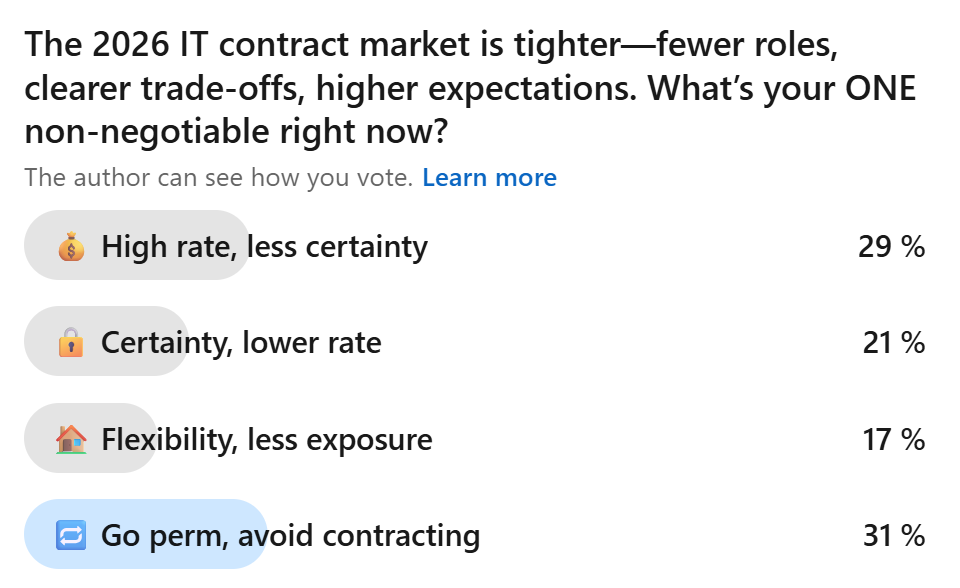
The shift toward permanency seen in the poll is driven less by ideology and more by risk calibration. With
31% of respondents indicating they would rather go permanent and avoid contracting, many technology professionals are reassessing how much uncertainty they are willing — or able — to absorb in the current environment.
A key driver behind the shift toward permanency is the very real memory of market whiplash experienced over the past few years. Many candidates have seen roles paused, extensions delayed, or projects stopped despite strong performance, reinforcing the reality that individual outcomes are often shaped by decisions far beyond their control.
In parallel, predictability has taken on greater value as hiring cycles lengthen and reentry into the market becomes more cumbersome. Extended interview processes, multiple approval layers, and slower feedback loops have introduced friction that makes job transitions more taxing than in previous cycles. Against this backdrop, permanency offers not just financial stability, but psychological relief — reducing the emotional fatigue associated with repeated job searches.
2. Staying Contract — But Re-Pricing Risk on Different Terms
At the same time, the poll highlights that a significant cohort remains committed to contracting — though on altered terms. Nearly half of respondents (see above chart) were split between prioritising higher rates despite less certainty (29%) and accepting lower rates in exchange for greater predictability (21%).
"Together, these responses point to a market that hasn't rejected contracting, but has re-priced the risk associated with it."
For some candidates, particularly those with deep, immediately deployable expertise, contracting remains a rational and appealing choice. Where skills are scarce and outcomes are mission-critical — in areas such as platform modernisation, security, data, AI-enabled delivery or regulatory change — employers continue to pay a premium. For these professionals, the likelihood of re-engagement remains relatively high, making higher rates a reasonable tradeoff for reduced certainty.
For others, the cost of income disruption — delayed starts, shortened contracts, uncertain extensions — can outweigh the upside of maximising rate. Trading some price for longer tenure, clearer funding or extension confidence becomes a deliberate form of risk control rather than a concession.
So, What is 2026 Is Really Telling Us?
The Australian ICT employment market in 2026 is not broken — it is recalibrating.
Employment is holding, roles still exist, and pay signals remain firm. But confidence is fragile, and the tolerance for risk has shifted.
For individuals navigating this market, progress starts with clarity:
- How much uncertainty can you realistically carry this year?
- Where is your skill set genuinely scarce — and where is it interchangeable?
- How much exposure do I have to decisions that sit outside my control — funding cycles, approvals, or shifting priorities?
2026 is unlikely to reward reflexive decisions or waiting for perfect conditions. It will favour those who stay engaged, assess opportunities deliberately, and align choices with their personal risk profile.
If you're reassessing your direction — contract, perm, or somewhere in between — a conversation can often bring clarity quicker than more data.
I'm always open to talking through scenarios, pressures and trade-offs as people navigate what is shaping up to be a more complex, but still opportunity-rich year.
Thanks again for reading,
Matthew.

Matthew Andrews
Talent Partner
Technology Recruitment and Professional Services Augmentation