
July update: The Australian ICT employment market - what recalibration actually feels like on the ground

In April, I wrote that the Australian ICT employment market isn’t broken — it’s recalibrating. That view still holds.
But in the weeks since, what we’re now seeing is what recalibration actually feels like on the ground.
The data continues to suggest that employment is holding and pay signals remain relatively firm. But confidence — across both employers and job seekers — has become increasingly fragile. Decisions are slower, risk tolerance is lower, and what once felt like a temporary adjustment is now starting to shape how people think about their careers and hiring strategies more broadly.
"More importantly, the lived experience behind this data is becoming harder to ignore."
Across conversations with candidates, there is a consistent theme — finding a role right now is tough. Not just because of competition, but because of what the process demands. The time spent preparing applications, navigating interviews, managing rejection, and maintaining momentum can be exhausting. It’s often described as a full-time job in itself — and for many, that’s exactly how it feels. The mental and emotional load that comes with that is significant, and often overlooked.
At the same time, employers are navigating their own challenges — though these are often poorly understood externally and not always communicated in a way that reflects the complexity organisations are dealing with.
This article builds on both real-time data and what we are seeing day-to-day in the market to explore what this environment means in practice — for those currently looking for work, for those planning their next move, and for organisations trying to make the right decisions in an uncertain landscape.
Where is the friction coming from in business?
As we approach the end of the financial year, a consistent theme has been emerging across conversations with clients in the Queensland IT market.
Across organisations, there’s a clear shift in mindset. The dominant tone is one of caution. Decisions that might have moved quickly 12 months ago are now being reassessed, challenged, and more tightly aligned to immediate business outcomes. In many cases, this is translating into restructures and tighter budgets.
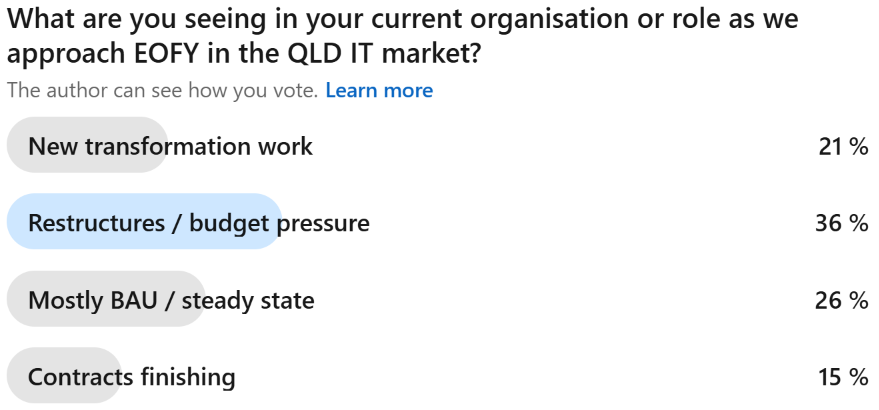
"At the same time, there is a noticeable “holding pattern” across parts of the market."
Many organisations are not stepping back entirely, but they are choosing stability over expansion. Existing systems are being maintained, core projects continue to be delivered, and teams remain in place — but there is a reluctance to take on new risk or commit to large-scale initiatives without greater certainty. This is typical of the pre-EOFY period.
For employers, this presents a nuanced landscape. On one hand, organisations are grappling with how to deliver effective strategic workforce planning in an environment that is both uncertain and rapidly shifting. Decisions around hiring are no longer straightforward, with leaders needing to balance immediate cost pressures against longer-term capability needs, often with limited visibility beyond the next budgeting cycle.
At the same time, employers now have more options than ever when it comes to how work gets delivered. Traditional hiring is just one lever among many — alongside IT vendors, offshoring strategies, contingent labour, and optimising existing BAU teams. This increased flexibility creates opportunity, but also complexity.
Overlaying all of this is the rise of AI investment. Organisations are moving forward, but many are still unclear on what it ultimately means for their workforce — particularly around how roles will shift and where capability should sit.
Where is the frustration stemming from Candidates?
Having spoken to many candidates over the past 12 months, these poll results really reinforce what I've been hearing in conversations across the technology market.
The overarching theme appears to be gaining momentum and traction in the first place. Many professionals are telling us that they're putting in considerable effort, applying for suitable opportunities and staying active in the market, yet finding it increasingly difficult to get noticed and progress through the early stages of recruitment.
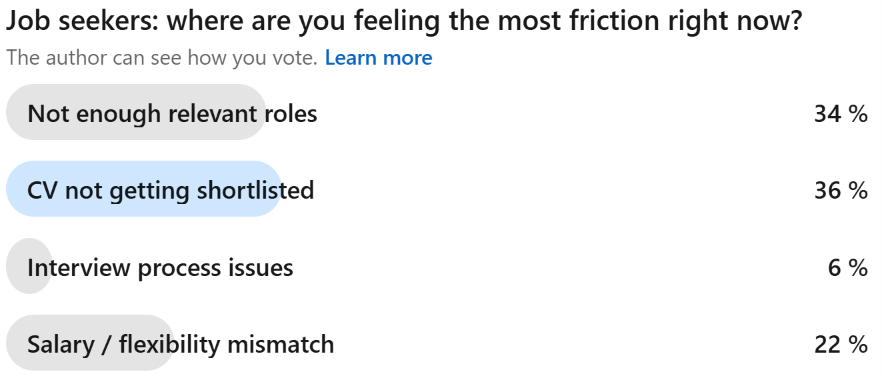
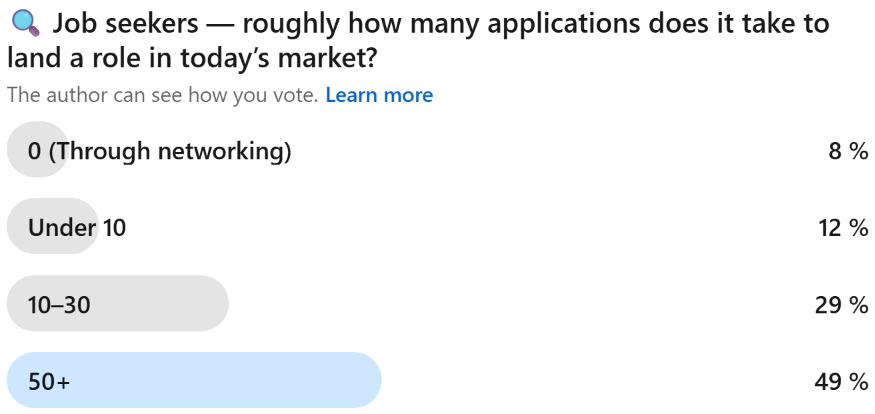
There's also a sense that the market has become more crowded and more selective. Candidates aren't necessarily questioning their capability but many are questioning why opportunities aren't converting into conversations. For some, the frustration comes from a lack of relevant vacancies. For others, it's the feeling of applying for roles that appear well aligned to their experience but not receiving a response or interview invitation.
The practical takeaway is that today's market appears less focused on securing the highest salary or navigating complex interview processes, and more focused on standing out in a busy field. For candidates, that means being strategic, targeted and visible.
Conclusion
While the challenges facing employers and candidates may look different on the surface, the reality is that both groups are navigating the same uncertain market conditions. Employers are trying to make thoughtful hiring decisions with tighter budgets, changing priorities and competing delivery models. Candidates are trying to position themselves effectively in a more competitive and selective market. The frustration that exists on both sides is real, but so too is the common ground.
The candidates seeing the most success right now are often those demonstrating what I would describe as "recruiter instincts". They are researching the market, targeting opportunities selectively, building networks, understanding employer motivations and focusing on visibility rather than simply increasing application volume. In many ways, they are approaching their job search with the same strategic mindset that hiring teams and recruiters apply to talent attraction.
Ultimately, the biggest takeaway from these findings is that success in today's market requires perspective. Employers benefit from understanding the effort, uncertainty and resilience required of modern job seekers. Equally, candidates benefit from understanding the commercial realities and constraints influencing hiring decisions. The more each side understands where the other is coming from, the more productive the conversation becomes.
If you're reassessing your direction — contract, perm, or somewhere in between — a conversation can often bring clarity quicker than more data.
I'm always open to talking through scenarios, pressures and trade-offs as people navigate what is shaping up to be a more complex, but still opportunity-rich year.
Thanks again for reading,
Matthew.

Matthew Andrews
4impact Talent Partner
Technology Recruitment and Professional Services Augmentation